

I have a confession to make.
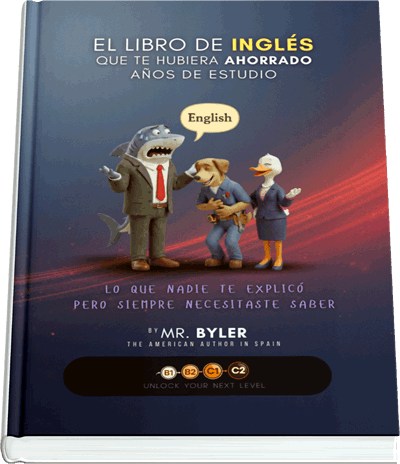
When you open the very first chapter of my book, “El Libro de Inglés que te hubiera ahorrado años de estudio”, you are greeted by a chapter called “Do sport” — El gimnasio imaginario. In it, I get pretty tough on anyone who uses the phrase “do sport.”
But if you look up “do sport” in the Cambridge or Oxford dictionaries, you’ll see it listed as perfectly correct. You might even find it in a BBC article.
So, did I make a mistake in my book? Am I fighting against the dictionary?
Not at all. In fact, writing that chapter was a deliberate teaching shortcut. It was a provocative nudge designed to shock your bilingual brain out of its comfort zone and break the habit of translating word-for-word from Spanish.
Because here is the real truth: “Do sport” is grammatically fine, but in everyday life, it makes you sound like a robot. Let’s look at why, and how you can start sounding like a real human being.

1. The Dictionary vs. Real Life
As an English learner, you need to understand a golden rule of language: A dictionary’s job is to tell you if a phrase exists. My job is to tell you if a native speaker would actually use it.
“Do sport” exists, but it belongs to the world of bureaucracy, public health reports, and clinical studies. You will see a British doctor in a government brochure writing: “It is vital for children to do more sport.”
It is dry, academic, and clinical.
But if your coworker asks about your weekend plans and you reply, “I’m going to do some sport on Saturday,” to a native ear, you sound like a spokesperson for the Ministry of Health. In everyday English, we don’t talk about “sport” in the abstract; we talk about specific actions.
2. The “Do, Play, and Go” Puzzle
In Spanish, the verb hacer is a linguistic Swiss Army knife. You “hace” the shopping, “hace” yoga, and “hace” sport. But English is much more specific. We divide physical activities into three strict categories:
- PLAY: Used for competitive team sports and anything involving a ball (play football, play tennis, play basketball).
- GO + -ING: Used for activities that involve moving from one place to another (go running, go swimming, go cycling).
- DO: Used for individual, structured, non-competitive activities that don’t use a ball (do yoga, do karate, do pilates).
And this is exactly why “do sport” sounds so bizarre. By pairing “sport” (which includes soccer and tennis) with “do”, you are accidentally telling a native speaker that you want to “do football” or “do tennis.” It just doesn’t fit.
So, how do you talk about physical activity in general? Instead of translating “hacer ejercicio” as the stiff “do exercise”, in conversational English we almost always use the verb to exercise or the incredibly common phrasal verb to work out (“I’m going to work out at the gym”).
3. The “Practice” Trap
To avoid “do sport”, many Spanish speakers fall into another trap: “I practice tennis.”
Be careful here, because practice in English has a very specific meaning. It doesn’t just mean “doing a hobby.” It means deliberate, repetitive training to master a highly specific technical skill.
- A pianist practices a difficult scale.
- A basketball player practices their free throws.
- An athlete practices their starting blocks.
If you tell a coworker on a Friday afternoon, “I’m going to practice tennis with my friend,” they won’t picture you having a fun, relaxed match and sharing a beer afterward. They will picture you sweating, looking intensely focused, and repeating your backhand serve a thousand times against a wall.
If you’re just playing for fun, keep it simple: “I’m playing tennis.”
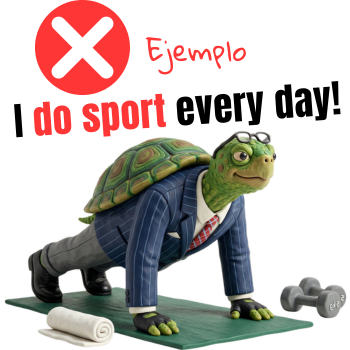

The Quick Cheat-Sheet for Your Next Workout
The next time you are packing your gym bag, use this quick guide to keep your English natural and fluid:
| What you mean to say… | ❌ Avoid translating as… | ✅ Say this instead! |
|---|---|---|
| Hacer deporte (General) | I do sport | I exercise / I work out / I play sports |
| Ir al gimnasio | I do gym | I’m going to work out |
| Jugar al tenis (Recreativo) | I practice tennis | I’m playing tennis |
| Salir a correr | I do running | I’m going running / I’m going for a run |
| Hacer yoga | I play yoga | I do yoga |
Are You Ready to Stop Translating in Your Head?
Linguistic inertia is a powerful thing, and translating word-for-word from Spanish is a hard habit to break. But recognizing these subtle differences is exactly what separates a perpetual English student from someone who actually achieves real, effortless fluency.
If you enjoyed this breakdown, you’ll love the rest of the book. In “El Libro de Inglés que te hubiera ahorrado años de estudio”, we dismantle over 200 of these invisible traps—not with dry, academic grammar drills, but with humor, real-world logic, and practical tips that stick in your brain forever.
💬 What about you? What is the one “classroom English” phrase that you were shocked to find out sounds weird to native speakers? Let me know in the comments!
Leave a Reply