

If you have ever screamed, cried, or quietly despaired over English phrasal verbs, you are in very good company. “I hate phrasal verbs!” is practically the official anthem of English learners worldwide.
For over a decade, I have worked as an English teacher in Burgos, Spain, balancing my life between there and Indiana, USA. I’ll let you in on a personal secret: I have a terrible memory, and I have always hated memorizing lists.
When I saw my students in Burgos struggling to learn phrasal verbs, I realized they were trying to memorize long, dry lists while I was relying on a simple feeling. They were smart, and their grammar was careful, but they would freeze in real conversation.
If you have tried to memorize 50, 100, or 300 phrasal verbs only to freeze when watching Netflix or speaking in real life, you are using the wrong tool.
The Screwdriver and the Bread
Imagine someone hands you a screwdriver and asks you to cut a loaf of bread. After twenty minutes of tearing the bread into a crumbly, frustrating mess, would you throw up your hands and say, “I am bad at cutting bread”? No. You would say, “I need a different tool.”
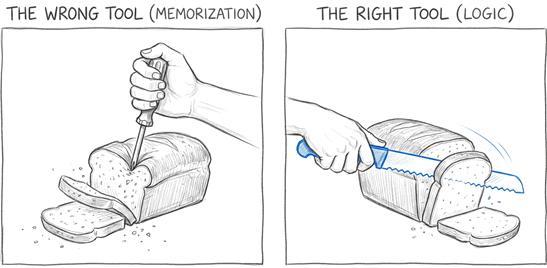
Trying to learn phrasal verbs through rote memorization, what I call The List Method, is exactly like trying to cut bread with a screwdriver. It treats every phrasal verb as an isolated “dot” on a map with no streets or landmarks connecting them. You might memorize where a few dots are, but the moment you actually arrive in the city of English conversation, you are completely lost.
What you need is a map with streets. You need The Logic Method.
The Secret of “Native Power”
Here is a liberating secret: native English speakers do not memorize phrasal verbs: they feel them. In fact, native speakers make up new phrasal verbs on the spot all the time, and other native speakers understand them instantly.
How? Because they understand the secret code of the PARTICLE.
In any phrasal verb, the base verb (like get, take, make, go, or set) is just a neutral, empty, gray LEGO brick. It holds the phrase in place, but it carries almost no directional meaning on its own. The magic happens when you snap a colorful particle like UP, DOWN, OUT, or OFF on top of it. The particle carries the real meaning.
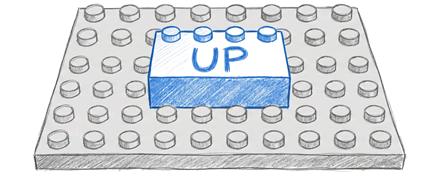
By learning the “directional energy” of just 10 simple particles, you gain the Native Power to decode thousands of phrasal verbs without ever opening a dictionary.
The Ultimate Relief: The 3-Level System
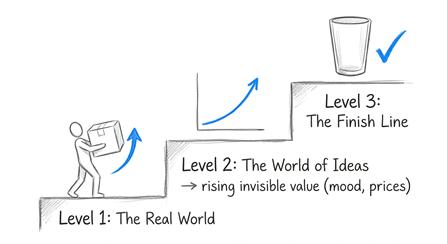
To make this practical, my book Learn Phrasal Verbs Without Memorizing Them introduces a simple, elegant tool called the 3-Level System. It proves that every particle works on three progressive steps:
- Level 1: The Real World (Physical). This is a literal direction you can physically see with your eyes. For example, when you lift up (raise) a box, the object physically moves toward the ceiling. This physical direction is like a stick figure climbing a ladder.
- Level 2: The World of Ideas (Abstract). This is the exact same direction, but applied to something invisible like emotions, sound, or prices. When your mood rises, you cheer up (brighten). When a voice increases in volume, you speak up. You can’t touch a mood or a voice, but they still climb an invisible scale, much like a line graph rising.
- Level 3: The Finish Line (Completion). At Level 3, the particle stops representing physical movement and instead confirms that an action is 100% finished.
Think of a glass of water. If you pour water into it, the level rises slowly. And then, at the very last drop, the water meets the rim—the glass is full, the action is complete.
This “Finish Line” logic is why we add UP to so many everyday verbs:
- You don’t just “use” a resource; you use up (exhaust) the gas until the tank is completely empty.
- You don’t just “finish” a meeting; you wrap up (conclude) the session when it reaches its final target.
- You don’t just “lock” a shop; you lock up (secure) every single door and window until the building is totally sealed.
The “Clean UP” Lesson
To see how practical this is, think about the difference between a task and a standard.
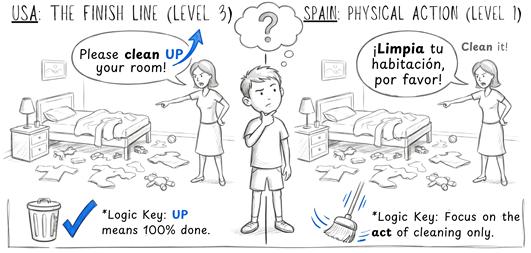
I grew up in a household where my mother spoke English and my Spanish friends’ mothers spoke Spanish. If my Spanish friends’ mothers wanted them to clean, they simply said, “limpia la habitación” (clean the room). That was just a task.
But my mother always told me to clean up his bedroom. That was a binding contract. She didn’t want me to just go through the motion of cleaning. The particle UP meant the room had to be cleaned until “the glass was full”—no toys under the bed, no messy shelves, 100% finished.
My mother used one small particle to remove all negotiation from the sentence. The particle wasn’t noise; it was the standard of arrival.
The Register Bridge: Your Safety Net and Your Wings
If your first language is Spanish, French, Italian, Portuguese, or Romanian, you actually have a massive built-in advantage.
Throughout my book, you will see the Register Bridge. On one side sits the phrasal verb (two words, short, everyday). On the other side sits the formal equivalent (one word, longer, often from Latin).
Words like exhaust (use up), postpone (put off), and discover (find out) are words you likely already recognize because they share Latin roots with your native language.
The formal Latin word is your safety net; the phrasal verb is your wings.
You can use the formal, Latin-based words in professional emails or academic reports to stay correct. But when you want to sound like a natural human being during a coffee break, you use phrasal verbs. Nobody says “please exhaust the milk” at breakfast!
From Memorizer to Decoder
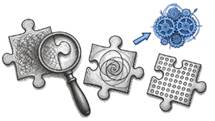
The traditional way of learning locks you in a cycle of shame. You stare at a list, forget the words a week later, blame your brain, and go right back to the same broken list.
But once you understand the logic, you experience an identity shift. You stop being a passive “Memorizer” and become an active “Decoder”. The next time you meet a strange phrasal verb in a film or a business meeting, you won’t panic. You will simply look at the particle, ask yourself which of the three levels it points to, and laugh as the meaning clicks into place like a key fitting into a lock.
Stop memorizing. Start decoding. Your wings are waiting.
Leave a Reply