
Clinical & Bedside Communication · CNAs, HHAs & IENs
You already know how to do your job.
Now you’ll have the exact words in English.
During a 12-hour shift, there is no time to mentally translate. Deliver crisp clinical reports in under 60 seconds, eliminate phone anxiety when paging the Charge Nurse, and write bulletproof, legally defensible care notes.
⭐ 269 pages · 14 floor-tested units · 5 pocket frameworks · Paperback Workbook & Kindle Interactive Edition
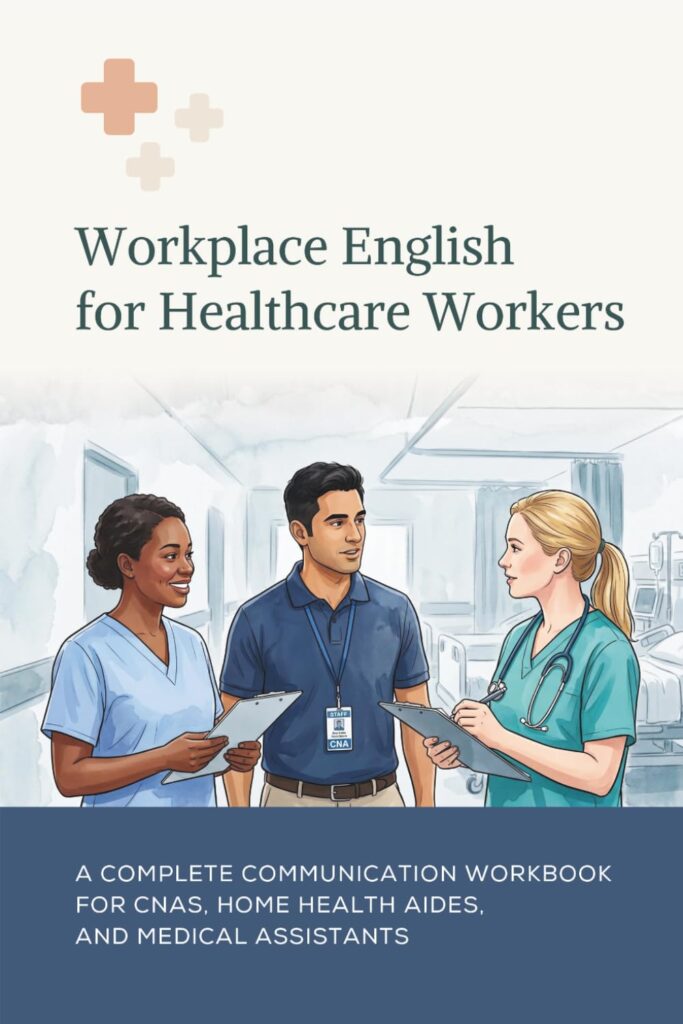
The On-Shift Freezing Effect
You spot your patient’s clinical decline immediately. But under pressure, the words freeze.
You know your care routines inside out. You instantly catch diaphoresis, subtle changes in breathing, sudden pallor, or acute guarding. But when you step up to the Charge Nurse or dial the on-call supervisor at 3:00 a.m., the “freezing effect” takes over.
You hesitate, fall back on vague phrases like “She doesn’t look good,” and face sharp, impatient follow-up questions. Critical minutes slip away, shift friction builds, and your clinical competence is questioned. This book does not teach anatomy or care procedures: it gives you the exact verbal frameworks to communicate like the skilled healthcare professional you already are.
The Real Cost of Bedside Vagueness
vs. 60-Second Clinical Precision
Three daily healthcare scenarios where unstructured English puts patient care and your license at risk:

❌ VAGUE SUPERVISOR REPORT
“The patient looks very bad and has pain.”
What happens: Frustrated interrogations from the Charge Nurse, delayed care, and perceived lack of control.
SBAR Clinical Standard:
“Room 12B appears diaphoretic, reports crushing substernal chest pain 8/10 radiating to left shoulder. Vitals pending. Requesting immediate bedside assessment.”
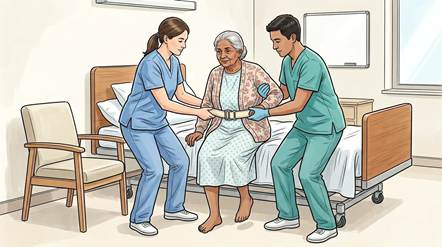
❌ SUBJECTIVE FALL DOCUMENTATION
“Patient fell because she was confused and refused help.”
The legal risk: Immediate vulnerability during state surveys, Joint Commission audits, or facility litigation for charting assumptions.
Objective Charting:
“Found resident seated on floor beside bed. Non-skid footwear in place. Resident stated: ‘My legs gave out.’ Denies pain. Charge Nurse notified immediately.”

❌ DEFENSIVE FAMILY INTERACTION
“I don’t know, that’s not my job, ask the doctor.”
The problem: Escalates anxious family members, triggers official complaints, and reflects poorly on your unit.
Scope-of-Practice Redirection:
“I completely understand your concern. The Charge Nurse oversees his medication adjustments. Let me check if she is available to discuss that right now.”
The Scrub-Pocket Toolkit
The 5 Clinical Frameworks by Mr. Byler

Five structured verbal tools engineered to be copied onto pocket index cards and kept inside your scrubs on every shift:
01
The SBAR Template
Shift handoffs, urgent phone updates, and MD rounding summaries structured in 4 clean moves: Situation, Background, Assessment, and Recommendation.
02
Objective-Subjective Rule
The golden rule for EHR flowsheet charting: strictly separates measurable sensory observations from direct resident quotes, eliminating subjective opinions that trigger lawsuits.
03
Scope-of-Practice Set
Warm, professional phrasing to address complex family inquiries regarding meds or prognosis without exceeding certification boundaries or sounding indifferent.
04
Call-Out & Check-Back
Closed-loop verbal communication for acute emergencies (Code Blue, rapid transfers) where mishearing a room number or instruction puts patient lives at risk.
05
The Five Rights Checklist
Spoken verification routine for certified Medication Aides and techs, slowing the hands down and stopping near-miss dosage or route errors before they occur.
Improvising Under Shift Pressure
vs.
Meeting the US Clinical Standard
| Unstructured Language (High Clinical & Legal Risk) | Professional Standard With This Workbook |
|---|---|
| Opens supervisor calls apologizing for English or hesitating over the phone. | Executes a firm 4-step call structure: Identification, Location, Objective Finding, Request. |
| Spends 20 chaotic minutes handing over shift updates in the facility hallway. | Delivers a crisp, 60-to-90 second SBAR handoff per resident with baseline comparisons. |
| Charts defensive or speculative notes that blame residents after unwitnessed falls. | Writes 100% objective, sensory-grounded EHR notes that withstand survey audits. |
| Feels invisible, hesitant, or apologetic during shift huddles and MD rounds. | Frames international credentials and hands-on skill as a respected clinical asset. |
14 Floor-Tested Units Built for Direct Care
Zero academic theory. Zero hotel or airport dialogues. Every unit tackles a real-world healthcare dilemma:
- Chapter 1: Core Medical Vocabulary & The “Appears” Rule.
- Chapter 2: From “He Doesn’t Look Good” to Clinical Precision.
- Chapter 3: The Handoff: Mastering SBAR Across Shift Changes.
- Chapter 4: The Phone Call: Paging Supervisors Without Hesitation.
- Chapter 5: Beside the Bed: Patient Introductions & Care Refusals.
- Chapter 6: Family Conversations: Compassionate Bedside De-escalation.
- Chapter 7: Care Notes & Clinical Documentation: 15 Defensible Exercises.
- Chapter 8: Emergency Communication: Call-Outs & Facility Codes.
- Chapter 9: Interprofessional Care: Updating Therapists, MDs & Peers.
- Chapter 10: ADL English: Dignified Hygiene, Turning & Feeding Protocols.
- Chapter 11: Five Rights of Medication & Fall Prevention Procedures.
- Chapter 12: End-of-Life, Mental Health & Sensitive Disclosures.
- Chapter 13: US Healthcare Workplace Culture: Indirect Feedback & HIPAA.
- Chapter 14: Career Advancement: Action-Verb Resumes & Bridge Programs.

About the Author
Mr. Byler
Clinical ESL Specialist & Author
An American educator raised in the Midwest, Mr. Byler specializes in clinical ESL instruction, linguistic interference, and high-stakes workplace communication. With over a decade of experience training non-native adult professionals, he focuses on diagnosing performance anxiety and eliminating the psychological freeze response that healthcare workers experience under acute shift stress.
His methodology rejects abstract academic grammar in favor of floor-tested systems aligned with US regulatory and clinical standards (OSHA, The Joint Commission, HIPAA, and SBAR protocols). He engineers structured verbal frameworks that empower direct care staff (CNAs, HHAs) and internationally educated clinicians (IENs) to deliver patient care with confidence, dignity, and legally defensible precision.
Frequently Asked Questions
Which healthcare roles is this workbook designed for?
It is specifically built for direct patient care providers in the United States: Certified Nursing Assistants (CNAs), Home Health Aides (HHAs), Patient Care Technicians (PCTs), and Medical Assistants (MAs). It is also an essential workplace survival manual for Internationally Educated Nurses (IENs) and foreign-trained physicians currently working in care aide roles while completing US credentialing or taking the NCLEX-RN.
What if my general English is intermediate or conversational (B1 level)?
You will thrive. The entire curriculum uses Inline Scaffolding—step-by-step structural prompts that move from guided exercises to full shift readiness. You do not need complex grammar or rare words to deliver a 60-second clinical report; you need the exact 4-phrase patterns that American hospital units demand.
What is the difference between the Paperback and Kindle Interactive Edition?
The Paperback Edition is a traditional, large-format 269-page workbook with fill-in-the-blank spaces, open chart-writing drills, and classroom partner role-plays. The Kindle Edition has been digitally re-engineered for smartphones and e-readers using Mental Selection Drills and instant answer keys with detailed explanations (Language Power), without frustrating blank lines or awkward paper layouts.
Can US healthcare facilities, staffing agencies, or colleges adopt this?
Yes. Directors of Nursing (DONs), Staff Development Coordinators, and community college CNA program directors use this manual to standardize floor communication, reduce fall and medication near-misses, train international hires, and ensure EHR charting complies with state survey and Joint Commission standards.
Communicate with the Authority Your Care Deserves
Get your 269-page copy and replace hesitation with clinical confidence in every phone call, handoff, and chart note.