
A Contrastive Guide for Spanish Learners of English · B1 to C2
Years studying English…
and still translating from Spanish?
You memorized the three columns of irregular verbs in school, watch series with subtitles, and read emails without friction. Yet in a live meeting or sudden phone call, you hesitate, translate word-for-word from Spanish, and freeze. The problem was never your memory: it is your native Spanish mental map silently sabotaging how you speak.
El Libro de Inglés que te hubiera ahorrado años de estudio
Lo que nadie te explicó pero siempre necesitaste saber · By Mr. Byler
English Reference Title: The English Book for Spanish Learners: What Nobody Explained (Written in Spanish)
⭐ 380 practical reference pages · 1.12 kg · 200+ chapters & 5 thematic glossaries
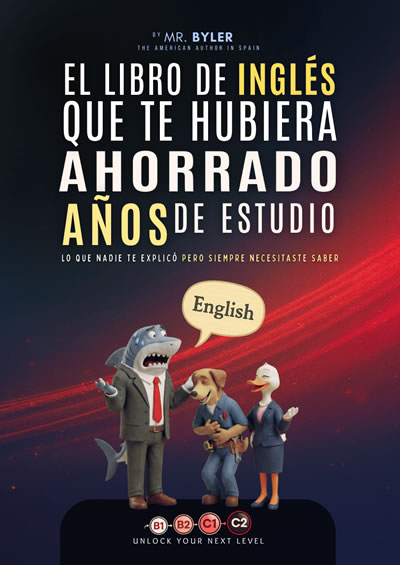
380 pages · Large format paperback & Kindle edition

The Classroom English Trap
Why do Spanish learners of English still make the same school-age mistakes?
Traditional English instruction in Spain prepared you to fill in exam blanks with a pen, not to think on your feet in a live international conversation. Teachers often insisted that «Spanish was forbidden in class», pretending your mother tongue did not exist. But your brain fundamentally thinks in Spanish. Under pressure, your mind automatically takes Spanish syntactic structures and dresses them up with English words.
The outcome is Invisible Spanglish: phrasing that might squeak past a lenient written test, but sounds stiff, childish, distrustful, or blunt to a native speaker. And in corporate settings, international clients and colleagues nod out of professional courtesy—no one ever pulls you aside to point out where you slipped up.
What you think you are saying
vs. What a native speaker actually hears
Four common scenarios where Spanish linguistic habits sabotage natural communication:

❌ IN BUSINESS MEETINGS
“Who is the responsible?”
What you think you say: “¿Quién es el encargado del proyecto?”
What a native hears: “Who is the guilty culprit behind this disaster or crime?”
Natural English: “Who is in charge?” or “Who is running this?”

❌ ASKING FOR CLARIFICATION
“I have a doubt.”
What you think you say: “Tengo una duda o pregunta sobre lo dicho.”
What a native hears: “I morally distrust your integrity or suspect you are lying.”
Natural English: “I have a question.”

❌ ON RESUMES & LINKEDIN
“I studied a career in Law.”
What you think you say: “Estudié la carrera universitaria de Derecho.”
What a native hears: “Did you study a 30-year lifetime of professional employment?”
Natural English: “I got a degree in Law.” or “I majored in Law.”
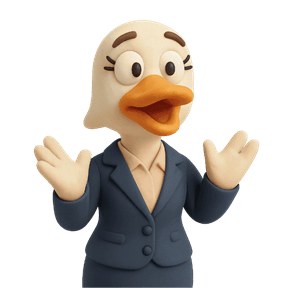
❌ ON CALLS & DAILY POLITENESS
“Wait a minute!”
What you think you say: “Espera un momento, por favor.”
What a native hears: A sharp military command bordering on outright rudeness.
Natural English: “Just a second…” or “Give me just a moment.”
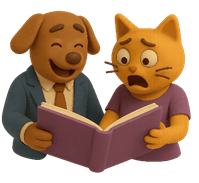
Three Books in One:
A Comprehensive Desk Reference
Forget flimsy 90-page exercise workbooks with fill-in-the-blank drills. El Libro de Inglés que te hubiera ahorrado años de estudio delivers 380 dense, direct reference pages organized into stand-alone micro-chapters you can read in order or flip to at random:
01
Logical Grammar & The Native Map
Deconstructs the mechanics of English without academic jargon: the non-negotiable Subject + Verb order, spatial orientation of prepositions, when conditional forms mislead, and how native speakers actually process ideas.
02
Dictionary of Invisible Errors & False Friends
An exhaustive inventory of literal translations commonly made by Spanish speakers: career, sensible, sympathetic, reclamation, by defect, in the computer, and dozens of fossilized pitfalls that standard exams never address.
03
Native Collocations & Real Idioms
Learn natural verb-noun combinations used daily on the street and in professional settings (take a decision vs. make a decision, the real logic of play/do/go), plus key distinctions between British and American usage.
Studying with Traditional Methods
vs.
Speaking with a Native Radar
| The 90% Plateau (Involuntary Spanglish) | What You Achieve with This Manual |
|---|---|
| Memorizes endless alphabetical phrasal verb lists that vanish within days. | Understands the spatial orientation of each preposition once and for all. |
| Translates mentally from Spanish, producing stiff and unnatural sentences. | Constructs thoughts directly using high-frequency native collocations. |
| Hesitates in high-stakes meetings fearing embarrassing verbal blunders. | Speaks and writes executive emails with poise, politeness, and credibility. |
| Ignores the role of the mother tongue and keeps falling into identical traps. | Harnesses Spanish syntax through contrastive analysis to unlock native logic. |

About the Author
Mr. Byler
“The American Author in Spain”
An American educator raised between Indiana (USA) and Spain. With over a decade in the classroom teaching adult students and corporate professionals in Burgos (Big Ben School), Mr. Byler has meticulously documented the exact syntactic friction points of Spanish speakers.
His approach completely dismisses hollow «fluent in 30 days» shortcuts. Instead, he combines rigorous comparative linguistics, sharp humor, and real-world logic so you develop true linguistic instinct and permanent communicative security.
For Educators, Assessment Evaluators & Academic Diligence: Methodological Framework & Technical Specs
While this manual is deliberately written in an accessible, direct, and pragmatic tone for independent learners, its underlying pedagogical architecture is grounded in applied contrastive linguistics and cognitive grammar:
Remediation of Negative L1 → L2 Transfer
Systematic deconstruction of persistent Spanish substrate interference: null-subject parameter elisions, syntactic calques in causative structures, and high-frequency false cognates across formal and professional registers.
Collocational Competence & Idiomatic Chunking
Targeted lexical fixation through rigid prepositional colligations and multi-word semantic units, guiding learners away from literal word-for-word translation toward native pragmatic fluency.
Registered Publication (ISBN: 978-84-09-81561-6) · 380 pages · Comprehensive desktop reference manual for CEFR levels B1 through C2.

Download the First 4 Chapters for Free
Experience the clarity of the explanations and the rigor of the method before buying. Enter your email below to instantly receive the preview PDF containing the first 4 complete chapters of El Libro de Inglés que te hubiera ahorrado años de estudio (written in Spanish with full English breakdowns).
🔒 Zero spam. Unsubscribe anytime with a single click.
Frequently Asked Questions
Why are the explanations written in Spanish instead of 100% in English?
Because your cognitive framework functions in Spanish. Pretending your mother tongue does not exist blinds you to the exact root of your errors. Using Spanish as a conscious contrastive tool provides the analytical clarity required to identify transfer mistakes, dismantle them, and rewire your habits permanently.
I have an intermediate level (B1 or B2), will it be difficult to follow?
Quite the opposite: it is written in a direct, conversational tone with humor and relatable analogies. Zero unreadable linguistic jargon. Any learner at B1 level or above will experience a constant series of «Aha! So that’s why!» moments.
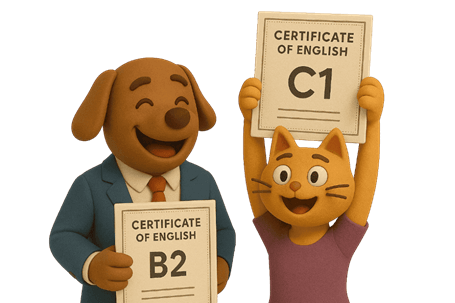
I already hold an official C1 or C2 certificate—will I learn anything new?
Guaranteed. Even advanced students routinely carry fossilized calques into daily speech (such as “related with”, “in the computer”, “by defect”, or overly abrupt phrasing in correspondence). This manual targets the subtle native nuances, registers, and collocations that standardized exams consistently overlook.
Is this a sequential course or a desk reference?
It is structured across 200+ self-contained micro-chapters. You can read it cover-to-cover, flip to any random section over coffee, or consult its 5 thematic glossaries right before drafting an email or hopping onto an important conference call.
What is the difference between the Paperback and Kindle editions?
The paperback edition is a heavy, large-format desk manual (21 x 30 cm, 1.12 kg, 380 pages) designed for continuous desktop consultation. The Kindle digital edition is reflowed and includes interactive Mini Quizzes tailored for quick self-testing on phones, tablets, or e-readers.
Activate Your Native Radar Today
Get your 380-page copy of El Libro de Inglés que te hubiera ahorrado años de estudio and communicate with the poise, accuracy, and confidence of someone who truly understands the logic of the language.