
Cognitive Visual Framework · Levels B1 to C2
Memorizing phrasal verb lists is completely useless.
And native speakers never do it.
How many alphabetical lists have you tried to cram into your head? How many do you actually remember when speaking under pressure? With thousands of combinations in English, no human brain can memorize them all. Native speakers don’t recall definitions from memory cards: we feel the physical direction of 12 core particles.
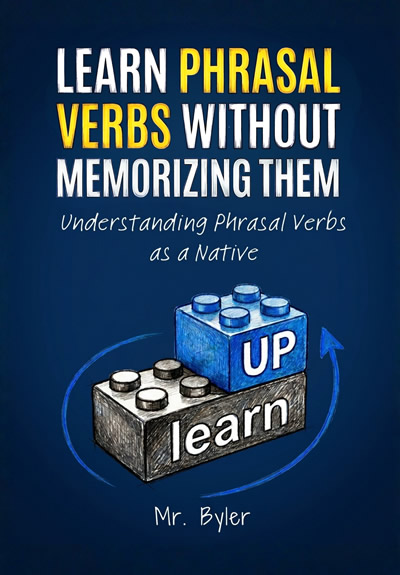
Learn Phrasal Verbs Without Memorizing Them
Understanding Phrasal Verbs as a Native · By Mr. Byler
Complete Desk Manual · 271 Pages of Directional Particle Logic & Real-Time Decoding
⭐ 271 pages of spatial logic · The 12 core directional particles · Zero rote memorization
The Flaw in Traditional Language Teaching
The alphabetical list trap: the ultimate ESL textbook filler
Why do virtually all language academies and grammar books throw a three-page alphabetical list of break down, break up, break out, break off at you? Because it’s easy for the teacher. It’s convenient to assign twenty verbs for homework and run a fill-in-the-blank quiz on Friday. It fills syllabus hours and justifies thick textbooks. But when you need to speak in real life, it leaves you completely stranded.
In English, there are thousands of phrasal verb combinations, and native speakers constantly invent new ones on the fly. Trying to memorize them one by one through sheer repetition is an impossible battle. No human brain has the working memory to retrieve thousands of disconnected definitions in 0.2 seconds during a fast conversation. Your memory is not the problem; the tool is the problem. Instead of memorizing lists, you must understand the spatial logic of the 12 directional particles that drive the entire language.
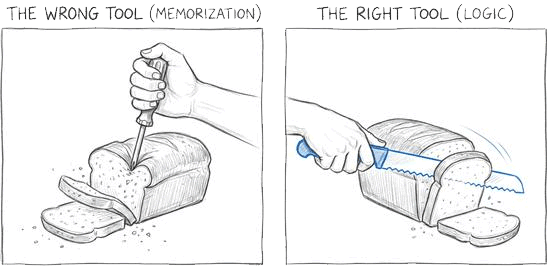
A seven-year-old native child in London or New York uses dozens of phrasal verbs every single day without knowing what a preposition is. They have never seen a grammar table in their lives. Native speakers invent new expressions and understand each other instantly because we don’t memorize words: we visualize physical direction and spatial boundaries.
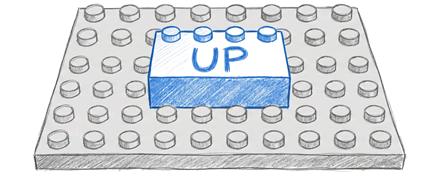
The LEGO Principle:
Stop staring at the verb; look at the particle
Generic verbs like get, take, set, put, or go are just plain, gray LEGO bricks. They have no intrinsic direction. The particle (UP, DOWN, OUT, OFF…) delivers 100% of the visual meaning:
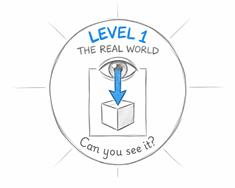
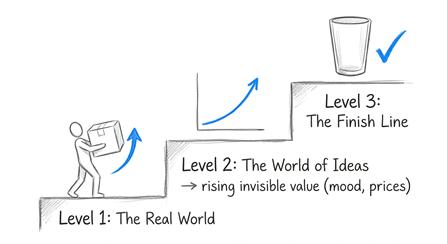
Level 1
The Real World
Visible physical movement. You can see it with your eyes or draw it on paper: climb UP (physically ascending), sit DOWN (lowering the body), walk OUT (leaving a room).
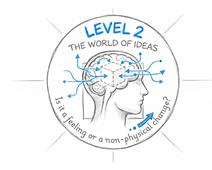
Level 2
Ideas & Invisible Scales
The same direction on mental scales. Volume, mood, or cost: cheer UP (mood rises on an invisible scale), turn DOWN (decreasing volume), speak OUT (bringing an idea into public view).
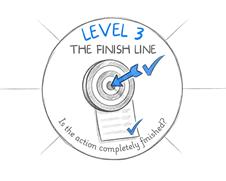
Level 3
The Finish Line
100% completion, exhaustion, or fixing in place. The glass filled to the brim: use UP (depleting a supply to zero), clean OUT (emptying completely), write DOWN (fixing thoughts on paper).
The Reality Check:
A Live Workplace Meeting
You are in an international video conference, and a colleague casually drops this sentence at full speed:
“Let’s wrap this up and push back the launch, because the contract might fall through.”

❌ THE LIST METHOD (TRANSLATION & FREEZE)
- Word-by-word literal translation: You try to make sense of wrap (wrapping gifts?) and push (pushing with hands?). Nothing fits an office scenario.
- Mental dictionary panic: Your brain frantically searches grammar flashcards and tables you tried to memorize months ago.
- The four-second lag: By the time you piece together what was said, the discussion has already moved on to the next agenda item.
- Forced silence: You remain quiet out of fear of misunderstanding, reinforcing the false belief that you are “bad at languages.”
⚡ THE LOGIC METHOD (0.2s NATIVE CLARITY)
- wrap UP (Finish Line): The particle UP brings the cycle to 100% completion. Immediate meaning: conclude the meeting now.
- push BACK (Directional Reversal): The particle BACK shifts the date backward along the timeline. Meaning: postpone the deadline.
- fall THROUGH (Falling into Empty Space): The floor gives way and the plan drops into void. Meaning: the deal collapses.
- Zero translation, zero lag: Your mind decodes a physical picture in real time, exactly like a native English speaker.
Cognitive Relief
“How am I supposed to process all that while speaking?”
If seeing this example made you think your brain will overheat calculating spatial vectors in a live conversation, take a deep breath. You are looking at the finish line before taking your first stride.
The book does not throw you into the deep end. Each of the 12 directional particles has its own dedicated, visual, step-by-step chapter.
- Step 1: Anchor the physical direction using everyday objects you already know (a cup, a door, a ladder).
- Step 2: Apply that same arrow to abstract scales (emotion, volume, time, budgets).
- Step 3: Your mind automates the picture. By the advanced chapters, you are no longer calculating: you see the scene without translating.
💡 The Native Reality: Native English speakers do not possess superhuman memory. We use spatial direction because it is effortless. This book installs that exact visual software in your mind.
Two subtle details that immediately transform your speech
1. The Loud Particle
(Acoustic Energy)
In many world languages, stress falls heavily on the root verb. In English, vocal stress lands squarely on the particle because that is where the meaning resides: we do not say PICK-up, we say pick-UP; we do not say FIND-out, we say find-OUT. Shifting your vocal punch to the particle makes you instantly sound natural to native ears.
2. The Pronoun Sandwich
(The Placement Rule)
Saying pick up it or turn off it instantly marks your speech as broken. Short personal pronouns (it, them, him, her) are the filling inside a sandwich: they must always go in the middle: pick IT up, turn IT off, plug IT in.
One mechanical rule that permanently eliminates one of the most common ESL speaking errors.
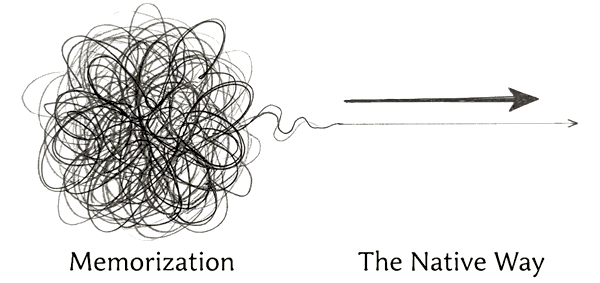
Rote Memorizer
vs.
Active Native Decoder
| The Rote Memorizer (The Traditional ESL Approach) | The Active Decoder (The Logic Method) |
|---|---|
| Spends hours cramming alphabetical tables that evaporate within two weeks. | Masters the directional compass of 12 particles and deduces hundreds of verbs effortlessly. |
| Freezes during fast video calls or when watching movies because they must translate. | Effortlessly catches high-frequency business phrasal verbs (wrap up, scale back, flesh out) in real time. |
| Makes clunky placement errors like *pick up it* without understanding why it feels wrong. | Automatically applies the Pronoun Sandwich (pick IT up) with natural rhythm. |
| Feels discouraged, assuming they have a “bad memory” or that phrasal verbs are totally arbitrary. | Understands spatial mechanics and speaks with the relaxed, intuitive confidence of a native. |
Download the Free Starter Guide & Chapter 1
Experience the clarity of The Logic Method before ordering your physical or digital copy. Enter your name and email to immediately receive the starter PDF covering the foundational 3-Level decoding system.
🔒 Zero spam. You can unsubscribe at any time with a single click.
For Linguists, Educators & Assessment Directors: Cognitive Methodology & Framework
While structured for rapid autodidactic acquisition, Learn Phrasal Verbs Without Memorizing Them: Understanding Phrasal Verbs as a Native is anchored in established models of Cognitive Semantics, Conceptual Metaphor Theory (Lakoff & Johnson), and Talmy’s Typology of Motion Events:
1. Satellite Framing & Spatial Vector Operators
English encodes path in satellite particles rather than root verbs. The manual isolates 12 topological vector particles (up, down, out, off, through), equipping learners to decode base verbs as modal carriers and particles as primary semantic drivers.
2. Systematic Aspectual Telicity
Deconstructs abstract particles via a 3-Level Cognitive Model: Level 1 (Physical Trajectory), Level 2 (Metaphorical Scales: Volume, Status, Emotion), and Level 3 (Telic Completion: Exhaustion, Fixation, Cessation). Solves working-memory overload by replacing rote lists with predictive conceptual mappings.
3. Acoustic Phrasing & Suprasegmental Stress
Remediates prosodic transfer errors in non-native speakers by shifting tonic accent to the directional particle (pick-UP vs. PICK-up), improving receptive comprehension in fast-paced professional exchanges.
4. Morphosyntactic Clitic Distribution
Automates the position of unstressed direct object pronouns (The Pronoun Sandwich), permanently eliminating persistent word-order errors (*put on it → put it on) through structured syntactic drills.
Curricular Reference: 271 pages · Standardized CEFR B1–C2 range · Applied linguistics framework designed for workplace and examination fluency.
Frequently Asked Questions
Why doesn’t this book contain alphabetical lists like other ESL manuals?
Because alphabetical lists group expressions that have zero logical or semantic relationship (such as get away, get by, get on, and get through), which instantly overloads your working memory. This book structures English around the 12 core directional particles (UP, DOWN, OUT, OFF…), allowing your mind to construct a permanent spatial map.
I have an intermediate level (B1 or B2). Is this book accessible for me?
It is specifically tailored for you. At B1/B2 you already know basic grammar, but phrasal verbs remain the stubborn barrier preventing you from speaking naturally or understanding fast-paced workplace conversations and TV series. The book is written in clear, direct English without dense linguistic jargon.
I already hold an advanced C1 or C2 certificate. Will I learn anything new?
Absolutely. Most advanced non-native speakers over-rely on single, formal Latinate words (such as postpone, discover, eliminate, recover) and end up sounding overly stiff, academic, or unnatural in spontaneous conversations. This book covers Double-Lock Verbs, the Fusion Zone, and the nuanced idiomatic registers that bridge the gap between academic accuracy and true native fluency.
What is the difference between the Paperback and Kindle editions?
The Paperback edition (271 pages, spacious 7 x 10 in / 17.78 x 25.4 cm desk format) is engineered for active study: pencil notes, highlighting, and keeping beside your workstation. The Kindle eBook edition is ideal for on-the-go review from your phone, tablet, or e-reader (and is included in Kindle Unlimited).

About the Author
Mateo Byler (Mr. Byler)
Educational Author, Applied Linguist & Official Assessment Evaluator
Dual-educated in the United States (Indiana) and Spain, Mateo Byler bridges native cultural fluency in General American English and Peninsular Spanish. He has logged over a decade of classroom instruction preparing executives, engineers, and healthcare professionals for high-stakes international performance.
Appointed as an independent English language assessment examiner for municipal public sector competitions (Ayuntamiento de Burgos) and course designer for accredited medical boards (COMBU), he developed the Cognitive Visual Framework to liberate analytical learners from the working-memory bottleneck of arbitrary lists.
Gain Native Power Today
Get your copy of Learn Phrasal Verbs Without Memorizing Them: Understanding Phrasal Verbs as a Native and decode everyday English with spatial precision.