
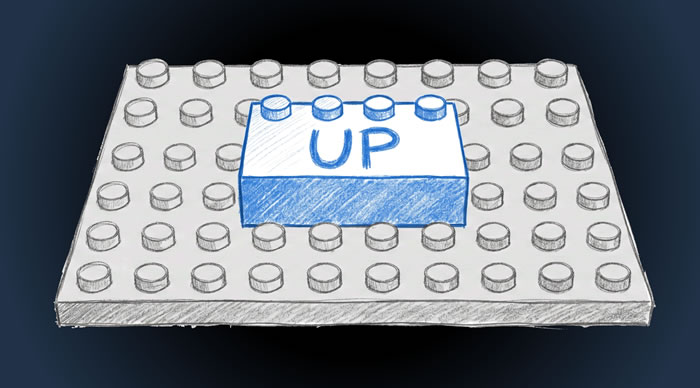
How many phrasal verbs have you tried to memorize in your life? Fifty? A hundred? A massive list of random words you copied into a notebook, hoping they would somehow stick?
Now ask yourself a harder question. How many of them stayed in your head when you actually needed them?
If you have been studying English for years, the answer is probably frustrating. You learn pick up on Monday. You learn give up on Tuesday. You learn use up on Wednesday. By Friday, your brain feels like a heavy bag of rocks, and when a native speaker uses a verb that was not on your list, you freeze.
I want you to close that thought right now. Your memory is fine. The list is the problem. You were given the wrong tool and then blamed for the poor result. Learning English through lists is like trying to cut bread with a screwdriver. After twenty minutes of struggle, you would not say “I am bad at cutting bread.” You would say “I need a different tool.”
This system is that different tool. It is a deep, extensive decoding framework written entirely in English, specifically built for intermediate learners who want to finally break past the vocabulary ceiling and master the language like a native speaker.
The Author’s Story: From Feeling to Logic
I grew up with English at home, but my life has been a bridge between two worlds: Indiana, USA, and Burgos, Spain. I moved to Spain when I was 7 years old. My education in the US was never about grammar charts, verb tenses, or rules. It was about literature and stories.
Because I lived in both languages, I used phrasal verbs every single day without knowing they had a special name. To me, words like UP, DOWN, and OUT were just physical directions. I could even make up new verbs on the spot because I saw the picture in my head.
When I started coaching English to adults and teenagers in Spain, I saw the problem from the other side. My students were smart and hardworking. Their grammar was careful. But when they tried to have a real conversation, something broke down. They were trying to memorize hundreds of individual facts, while I was using a simple feeling.
I realized native speakers have a secret. We do not memorize phrasal verbs. We feel a direction. The small word at the end, the particle, does 100 percent of the work. The base verb is just a neutral container. And that feeling is not magic: it is spatial logic.
The Hidden Code: The Map of Arrows
English is a highly spatial language. Native speakers organize thoughts using physical movement and directions. Once you learn to read the code of the particles, you stop needing a dictionary.
Look at these five verbs as a group. Do not think about their individual translations. Just look at what they share:
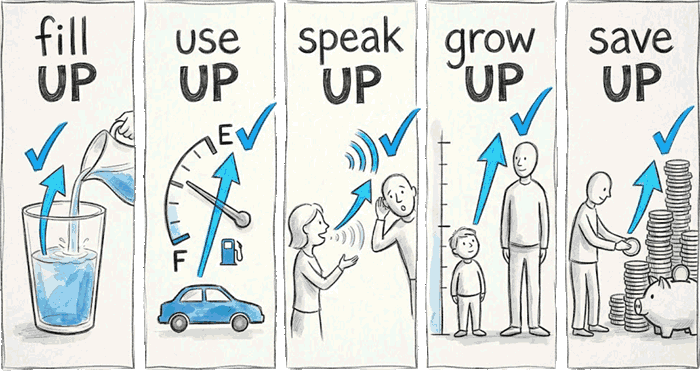
Five different situations: a glass of water, a tank of gas, a quiet voice, a child, and money. What do they all feel like?
In every single one, something is going from less to more. The glass fills. The voice rises. The child grows bigger. The savings scale higher. UP is a direction. It points from low to high, from empty to full.
Take use up (exhaust). Why do we pair use with UP to mean “finish completely”? If you keep using the milk in a carton, the liquid level drops. But the total amount you have used goes up, up, up, until it reaches 100 percent. The top. You have used it all the way UP. The direction is the meaning.
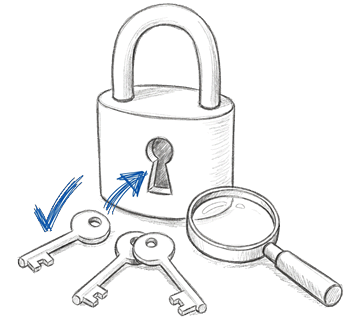
The 3-Level Architecture
Every single particle in the English language scales across three distinct steps. This is the staircase of meaning:
Level 1: The Real World
This is the physical level you can see with your eyes. Gravity is real, bodies move, and objects change position. When you climb UP a ladder or lift UP a heavy box, the particle points directly at the sky.
Level 2: The World of Ideas
This is the invisible level. We take the exact same physical direction and apply it to things we cannot touch, like moods, volume, prices, or speed. If a crowd cheers UP, their happiness rises on an invisible scale. The arrow still points upward: the scale is just mental.
Level 3: The Finish Line
This is the logic of total completion. It has nothing to do with vertical movement anymore. It is about reaching the absolute limit, like a glass filled to the very brim with a small checkmark next to it. When you wrap up a project or lock up a building for the night, the action is 100 percent finished.
The Register Bridge: Your Safety Net vs. Your Wings
Many intermediate students feel that phrasal verbs are just casual slang. This is an error. Phrasal verbs are the structural core of spoken English.
In my coaching, we use a tool called the Register Bridge to organize vocabulary. Every two-word phrasal verb has a formal, single-word partner:
| (Spoken Wings) | Formal Equivalent |
| use up | exhaust |
| find out | discover |
| put off | postpone |
The formal word is your safety net. Use it in a legal contract, a university essay, or an official email to a director. The phrasal verb is your wings. It is how real people actually speak at lunch, in meetings, and at home. If you say “please exhaust the milk” at breakfast, you sound like a textbook, not a human. You need both tools to be truly fluent.

Golden Rules for Speaking
To sound natural instantly, you only need to master three core physical habits when you use these verbs:
- The Pronoun Sandwich: Small object words like it or them must go in the middle of a separable verb. Always. Say pick it up, never “pick up it.” Think of the particle as the final destination on a journey: the pronoun must pass through the verb first.
- The Smooth Sound: A phrasal verb is two words on a page, but it is one single sound in the mouth. Do not say “pick… up.” Say pickup. Link the words together on a single breath.
- The Loud Particle: Let your voice lean on the direction. Do not say “PICK up.” Say “pick UP.” The direction carries the meaning, so the direction takes the heavy vocal stress.
Stop Learning. Start Thinking.
This system is an extensive, zero-compromise manual built for serious students who are ready to finish the memorization loop. Over 17 deep chapters, we dissect the ten core directional particles of English using hand-drawn whiteboard logic, practical formulas, and targeted puzzles.
Every chapter features a LEGO Spotlight showing how generic base verbs like get, take, or go are just empty, neutral blocks until the particle snaps on to give them intelligence. We untangle the strangest idioms in Confusion Corner, track real-world use in Context Clusters, and build a permanent lifelong reference vocabulary.
The code of the language has not changed. You just need the right map to read it.
Logic Check: Try it Yourself
Look at this phrasal verb. You have probably never studied it on a list:
to scale back
You know what a scale is (a system of steps or levels). You know the particle BACK means returning to a smaller, earlier position or reversing a forward path.
If a company announces they need to scale back their budget, what are they doing?
You can already see the picture, can’t you? They are stepping down on the slider, reducing the size backward from where it was. You calculated that using spatial logic. You did not memorize it. That is the Native Power.
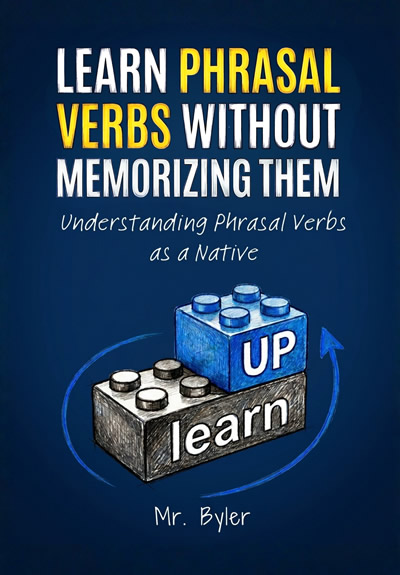
This blog post is a part of the framework from the book Learn Phrasal Verbs without memorizing them: Understanding Phrasal Verbs as a Native by Mr. Byler.
Leave a Reply